Addis Ababa (AMECO) — Ethiopia’s wide-ranging urban corridor development programme is reshaping cities across the country, offering a framework for infrastructure modernisation, green transit, and economic renewal without displacing local communities, according to university research and government officials.
First introduced in Addis Ababa during the 2016 Ethiopian calendar year (2023/24), the multi-purpose initiative has expanded nationwide—including across 43 towns in the Amhara region—as part of a broader suite of national mega-projects, including Gebeta LeHager (Dine for the Nation), Gebeta LeSheger, and Gebeta LeTiwolid.
A study conducted by Bahir Dar University indicates that the corridor works have significantly upgraded transport networks and municipal infrastructure. By expanding road links and improving market accessibility, the scheme has facilitated the flow of goods and services while opening new commercial opportunities for small traders and private investors.
Prime Minister Abiy Ahmed described the corridor strategy as a multi-purpose urban model that modernises existing cities in situ rather than uprooting residents to build anew. He noted that the approach generates immediate employment while providing university graduates with hands-on technical design and construction experience.
In the capital, thousands of substandard plastic structures were replaced with standard residential housing within months. Upgrades to street lighting, roads, and public safety infrastructure have also boosted local property values, encouraging private investment in high-yield sectors.
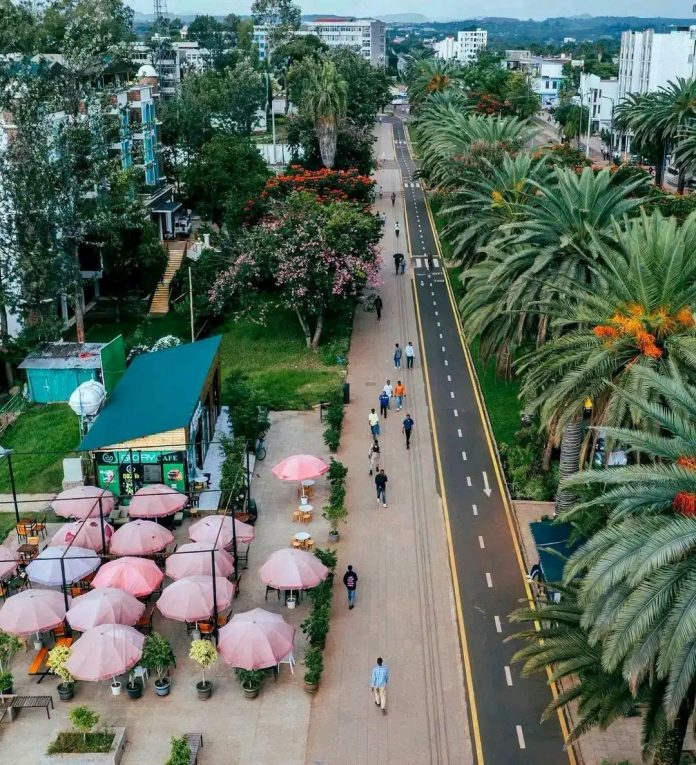
Urban mobility has improved through the separation of pedestrian walkways and driving lanes, alongside the construction of alternative routes to ease traffic congestion. The design prioritises non-motorised transport and pedestrian activity while implementing uniform color schemes, structural quality controls, and expanded street lighting to enhance night-time safety.
Environmental restoration forms a central pillar of the initiative. Waterways and riverbanks previously regarded as public health hazards have been converted into recreational green spaces that help mitigate urban heat island effects. Municipal authorities report notable reductions in noise, air, river, and roadside pollution.
To foster social cohesion and civic pride, the scheme has incorporated public parks and community football pitches into neighborhood designs. Officials report that the capital’s urban transformation is also boosting domestic and international tourism, acting as a gateway to regional hubs such as Arba Minch, Hawassa, and Bahir Dar.