AMECO AFRICA | ADDIS ABABA
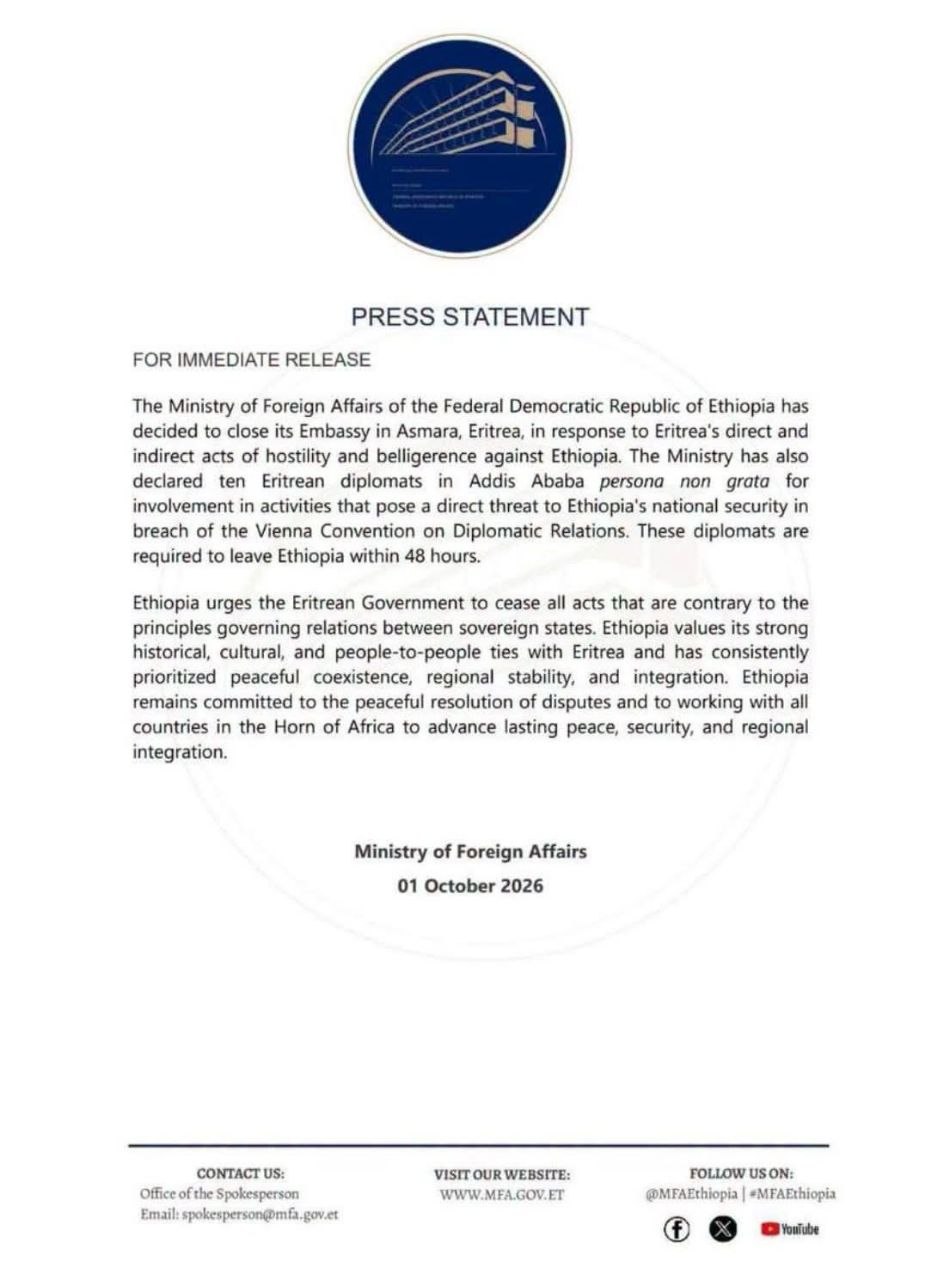
When the Ministry of Foreign Affairs of Ethiopia shuttered its Embassy in Eritrea and delivered 48-hour expulsion notices to ten Eritrean diplomats alongside an Egyptian envoy on October 1, 2026, it marked a decisive turning point in regional diplomacy. Behind the formal diplomatic mechanics lay a long-standing, systemic assault on Ethiopian statehood—a deliberate campaign of covert subversion and regional hostility by the regime in Eritrea, operating in strategic synergy with Egypt to dismantle Ethiopia’s internal stability and restrict its national potential.
For years, Eritrea has leveraged covert operations, cross-border proxy networks, and intelligence vectors under diplomatic cover to weaken central state authority. Facing this multi-front campaign designed to fracture the nation from within, Ethiopia’s actions are not merely routine diplomatic retortions; they represent a lawful, measured, and imperative exercise of state defense. Ethiopia’s national sovereignty and core security interests have been severely compromised, and the nation holds every legal, moral, and strategic right under international law to defend its statehood and enforce its red lines.
1. The Anatomy of Violation: How the Eritrean Regime Undermines Ethiopian Sovereignty
The international legal order rests upon the foundational principles of state sovereignty, territorial integrity, and non-interference in domestic affairs, as codified in Article 2(7) of the United Nations Charter. The Eritrean regime’s ongoing conduct represents a deliberate, multi-pronged violation of these core tenets:
-
Direct breach of non-intervention: The ruling apparatus in Eritrea has engaged in continuous acts of hostility by logistically sustaining, financing, and advising domestic disruptive elements aimed at weakening central state governance and destroying national cohesion.
-
Systemic abuse of diplomatic status: Intelligence officers operating under diplomatic cover in Addis Ababa systematically breached Article 41(1) of the 1961 Vienna Convention on Diplomatic Relations, which explicitly prohibits diplomatic personnel from interfering in the internal affairs of the host state.
-
Operational synergy with Egypt: Eritrea’s covert maneuvers function in concert with Egypt’s regional containment policy, actively seeking to keep Ethiopia internally consumed and obstruct its major socio-economic and strategic infrastructure projects.
-
Violations of customary international law: As established in international jurisprudence—most notably by the International Court of Justice in Nicaragua v. United States—providing operational assistance, logistics, or safe havens to irregular forces targeting a sovereign state constitutes an unlawful act of indirect aggression.
2. The International Legal Foundation for Ethiopia’s Decisive Response
International law does not require a sovereign state to endure covert subversion passively. When confronted with persistent, hostile interference, a nation is fully empowered to execute defensive measures grounded in treaty law and customary international practice:
-
Absolute right of retortion: Under Article 9 of the Vienna Convention on Diplomatic Relations, Ethiopia possesses the absolute, unquestioned right to declare any member of a diplomatic mission persona non grata without detailing specific cause, providing a firm, legal mechanism to dismantle foreign espionage rings.
-
Inherent right to self-defense: Article 51 of the UN Charter confirms the inherent right of states to safeguard their political independence and territorial integrity against both conventional military threats and sustained, state-sponsored asymmetric aggression.
-
Lawful and proportional countermeasures: Expelling hostile diplomatic personnel within a strict 48-hour window and closing diplomatic operations in an aggressor state represent measured, non-kinetic countermeasures specifically designed to neutralize active security risks without causing unnecessary regional escalation.
3. Procedural Recourse and the Diplomatic Timeline
The formal diplomatic steps executed by the Ministry of Foreign Affairs demonstrate a systematic, legally sound process designed to eliminate sovereign vulnerabilities while upholding international legal standards:
-
Verification of hostile networks: Exhaustive documentation established persistent breaches of the Vienna Convention and confirmed intelligence activities that posed direct threats to Ethiopia’s national security.
-
Formal issuance of diplomatic notifications: Official diplomatic notices were served to both the Embassy of the Arab Republic of Egypt and the Eritrean diplomatic representation regarding the specific expulsions.
-
Enforcement of the 48-hour departure window: Ten Eritrean diplomatic officers and Egyptian diplomat Ahmed Moharam Ahmed Soliman were directed to depart Ethiopian territory within 48 hours of formal notification.
-
Termination of sovereign operations in Eritrea: The full closure of the Ethiopian Embassy in Eritrea was executed in response to direct and indirect acts of belligerence, effectively isolating the sources of subversion.
4. Diplomatic Guardrails and Strategic Balance
While asserting its sovereign mandate, Ethiopia maintains a principled distinction between foreign ruling regimes and broader regional stability:
-
Distinction between regime and population: Official state communications explicitly affirm that these defensive actions target state hostility rather than civilian populations, highlighting the enduring historical, cultural, and human bonds between the peoples of Ethiopia and Eritrea.
-
Commitment to Horn integration: By anchoring its actions strictly within international legal frameworks, Ethiopia demonstrates to regional partners and African Union allies that its measures are defensive necessities aimed at restoring regional balance and stability.
-
Enforcement of sovereign red lines: The joint diplomatic action addressing hostile vectors from both Eritrea and Egypt establishes an unambiguous boundary: Ethiopia will not allow its territory or internal security to be used as a battlefield for foreign geopolitical agendas.
Conclusion
The era of enduring sovereign infringement under the guise of diplomatic patience is officially over. Facing coordinated hostility that directly breaches the UN Charter and the Vienna Convention, Ethiopia’s closure of its embassy in Eritrea and the targeted expulsion of hostile diplomatic personnel are lawful, necessary exercises of state authority.
To guarantee long-term stability and shield the nation from external sabotage, Ethiopia must unyieldingly enforce these established red lines, systematically dismantle foreign intelligence operations, and leverage international legal frameworks to hold hostile state actors accountable. Protecting the homeland requires uncompromising resolve: Ethiopia holds the unquestionable legal, moral, and strategic authority to protect its national sovereignty, defend its vital interests, and ensure its enduring statehood.