By pairing scientific restoration at Fasil Ghebbi and Lalibela with major investments like the Gorgora eco-resort, Ethiopia seeks to replace decades of site neglect with multi-generational economic assets.
Addis Ababa,(AMECO)— Ethiopia is executing a dual-track tourism strategy across the Amhara region, coupling high-precision heritage conservation with modern eco-tourism infrastructure to build a resilient, long-term regional economy, Prime Minister Abiy Ahmed has stated.
Speaking in an interview with Amhara Media Corporation (AMECO), Abiy outlined an administrative shift away from past passive management toward a structured preservation and destination-development model designed to turn cultural assets into active economic drivers.
Restoring High-Risk Architectural Assets
For decades, world-renowned historical sites in northern Ethiopia suffered from structural decay, environmental weathering, and inadequate capital investment. The vulnerability of these aging monuments highlighted a systemic bottleneck: historic significance alone cannot guarantee site preservation without continuous, specialized technical interventions.
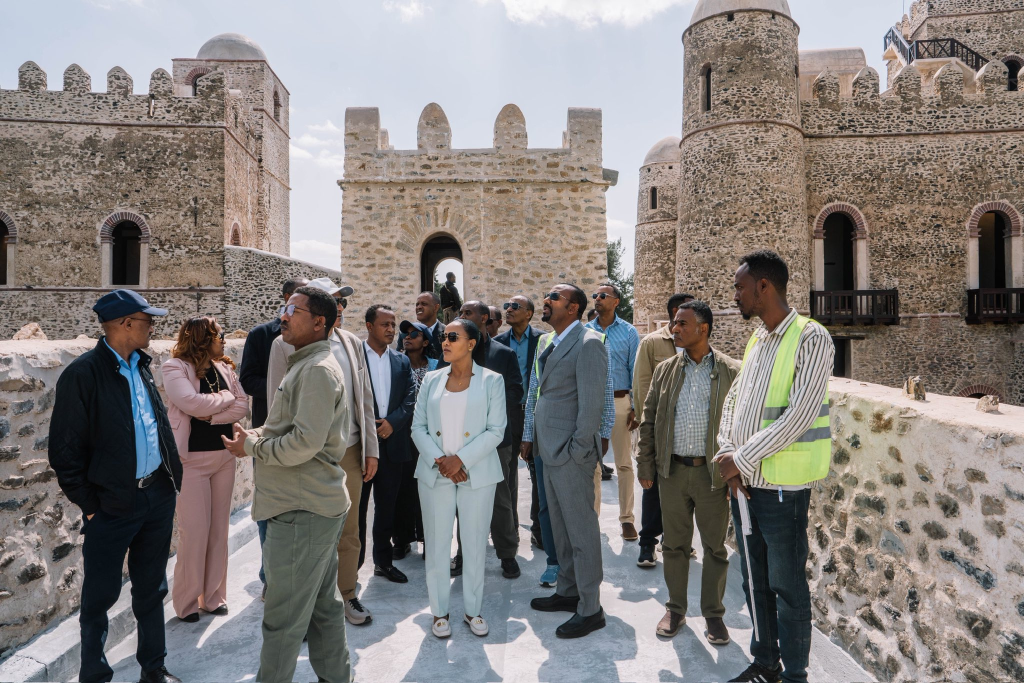
To arrest structural collapse, state-backed conservation teams recently completed extensive restoration work at the 17th-century Fasil Ghebbi palace complex in Gondar. Concurrently, the government expanded its technical partnership with French heritage authorities to implement structural preservation and long-term stabilization at the 12th-century rock-hewn churches of Lalibela, a UNESCO World Heritage site.
“We have undertaken magnificent restoration work on the aging Fasil Ghebbi palace,” Abiy noted, emphasizing that securing the physical integrity of foundational heritage sites remains a mandatory prerequisite for regional tourism recovery.
Building Sustainable Revenue Stream: The Gorgora Project
While heritage restoration safeguards existing assets, the government’s secondary objective focuses on expanding regional tourism capacity through modern eco-resort infrastructure.
The primary flagship of this strategy is the Gorgora eco-tourism project, located on the northern shore of Lake Tana. Developed under the national Dine for Generation initiative, Gorgora combines hospitality infrastructure, lakefront recreation, and environmental stewardship to capture high-value domestic and international travel demand.
Complementing Gorgora, new destination facilities at Lake Logo (Lake Hayq) have been developed to elevate regional hospitality standards and diversify revenue streams across South Wollo.
“The Gorgora project—a legacy that will transcend generations—was built in the Amhara region,” Abiy said, framing the development as a durable economic foundation that will serve rural communities for decades.
By linking scientific conservation with revenue-generating destination infrastructure, the administration is testing a scalable blueprint for managing cultural capital across the Horn of Africa.