
AMECO AFRICA / ADDIS ABABA
October 6,2026 – For decades, regional diplomacy in the Horn of Africa and the Middle East has been governed by a persistent geopolitical dogma: that the Red Sea belongs exclusively to the nations that touch its shores. This doctrine of “littoral exclusivity” treats maritime security as a gated community reserved for coastal states—Egypt, Sudan, Eritrea, Djibouti, Saudi Arabia, Yemen, and Jordan.
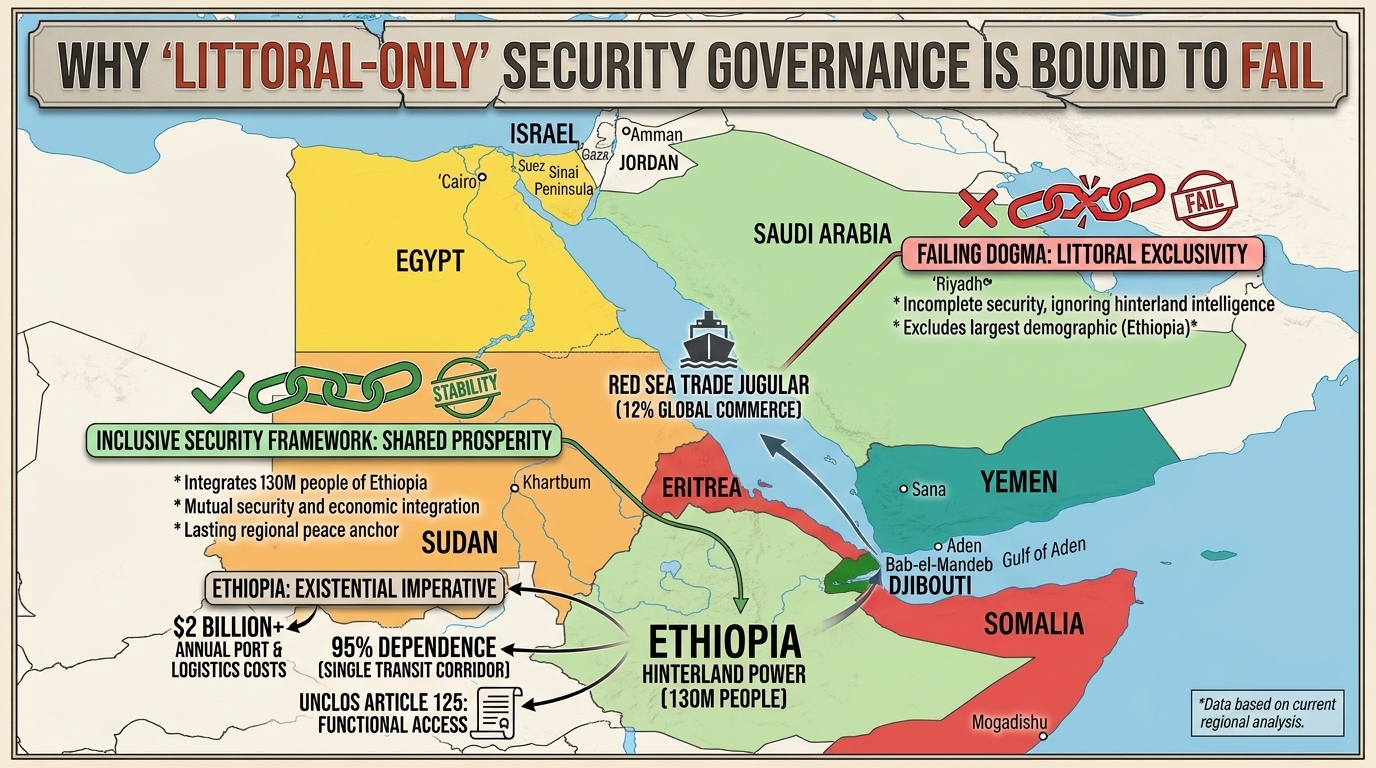
Yet, as recent maritime crises, missile strikes on commercial shipping, and soaring global supply chain costs have demonstrated, the Red Sea is not a tranquil inland lake. It is one of the world’s most critical maritime jugulars, carrying roughly 12 percent of global trade and 30 percent of international container traffic through the narrow choke point of the Bab-el-Mandeb Strait.
To suggest that security along this vital corridor is the sole prerogative of coastal nations is to ignore basic economic, demographic, and security realities. For landlocked nations in the immediate hinterland—most notably Ethiopia, home to 130 million people—Red Sea stability and direct maritime access are not remote diplomatic policy options. They are existential imperatives of national survival.
The Asymmetry of Maritime Insecurity
When security breaks down in the Red Sea, the economic fallout does not stop at the high-water mark. In fact, due to the structural vulnerabilities of developing economies, it is often the inland hinterland states that suffer the most severe and immediate shocks.
Consider the arithmetic of supply chain disruption. When commercial vessels are forced to reroute around the Cape of Good Hope to avoid conflict zones in the Red Sea, maritime freight rates surge, war-risk insurance premiums skyrocket, and transit times expand by weeks.
For a coastal state with diversified infrastructure or sovereign wealth reserves, these disruptions are manageable friction. But for a landlocked nation of 130 million people that routes approximately 95 percent of its international trade through a single coastal bottleneck, the consequences are catastrophic:
Imported Inflation: Essential goods—including agricultural fertilizers, fuel, pharmaceuticals, and machinery—become exponentially more expensive overnight.
Agricultural Disruption: Delayed fertilizer shipments during critical planting seasons directly threaten food security for tens of millions of smallholder farmers.
Foreign Exchange Drain :Annual logistics and transit fees—which already strip $1.6 billion to $2 billion out of Ethiopia’s foreign exchange reserves every year—spike higher, draining capital that should be building schools, hospitals, and industrial parks.
As economic strategist Dr. Fitsum Wolde-Giorgis notes:
“A landlocked country does not live in a vacuum. A missile fired at a cargo ship in the Bab-el-Mandeb does not just threaten maritime commerce; it inflates the price of bread in Addis Ababa and delays critical medical supplies in Hawassa. The economic vulnerability of the hinterland is direct, severe, and immediate.”
Geography and the “Hinterland Principle
In modern maritime economics, a port city or coastal strip does not exist in isolation. A port derives its economic value almost entirely from the size, productivity, and consumption capacity of its hinterland.
Ethiopia accounts for more than 70 percent of the Horn of Africa’s total population and economic output. It is the geographic and economic engine of the sub-region. Denying the region’s largest demographic powerhouse a formal, secure, and predictable stake in Red Sea security architecture creates an untenable imbalance.
In maritime international law, this relationship is recognized through the principle of functional access. The United Nations Convention on the Law of the Sea (UNCLOS) explicitly recognizes under Article 125 that landlocked states possess the fundamental right of access to and from the sea and freedom of transit. This legal framework acknowledges a simple reality: landlocked populations cannot be legally or economically trapped by the luck of political geography.
Why “Littoral-Only” Security Governance Is Bound to Fail
Attempts to build Red Sea security frameworks that deliberately exclude major hinterland powers are inherently flawed for three key reasons:
1. The Capacity Deficit
Many littoral states along the Red Sea face internal political fragmentation, economic distress, or limited naval projection capabilities. Excluding a neighboring state with a robust military apparatus, advanced intelligence capacity, and a vested interest in stability leaves the maritime corridor vulnerable to piracy, arms smuggling, human trafficking, and non-state armed groups.
2. The Illusion of Separation
In modern conflict, land and sea operations are seamlessly connected. Threats that manifest at sea—such as transnational smuggling networks or illicit arms corridors—frequently originate or find sanctuary deep within the continental interior. Effective maritime counter-terrorism and anti-smuggling operations require deep inland intelligence networks and land-sea logistical coordination that only major hinterland states can provide.
3. Demographic Weight and Long-Term Stability
Stability cannot be built by ignoring population centers. With Ethiopia’s population projected to reach nearly 150 million by 2030, any security framework that treats the Horn’s largest population center as an outsider guarantees perpetual friction, economic stagnation, and regional tension.
A former senior United Nations diplomatic envoy to the Horn of Africa summarized the imperative bluntly:
“You cannot construct a durable security dome over the Red Sea while leaving the region’s largest military power and most populous nation out in the cold. Inclusivity is not a concession to Ethiopia; it is a pragmatic requirement for regional peace.”
Toward an Inclusive Red Sea Framework
Addressing this challenge does not require violating the territorial sovereignty of coastal states or redrawing international borders by force. Rather, it demands a fundamental shift in regional mindset—moving from zero-sum coastal gatekeeping toward shared, multi-stakeholder security and economic integration.
A sustainable Red Sea architecture must be built on three core pillars:
1. Inclusive Maritime Governance: Integrating major hinterland nations like Ethiopia into regional maritime security councils, joint naval exercises, and anti-piracy task forces.
2. Diversified Port Partnerships: Encouraging commercial equity shares, long-term port leases, and joint infrastructure investments that turn coastal ports into shared economic engines rather than single-point bottlenecks.
3. Joint Security Corridors: Establishing co-managed transit corridors protected by multilateral security agreements, ensuring unhindered commercial traffic regardless of regional political fluctuations.
Conclusion: A Shared Future on the Horizon
The Red Sea is too vital, too volatile, and too interconnected to be managed through obsolete 19th-century notions of coastal exclusivity. The security of this crucial waterway and the economic survival of the nations surrounding it are inextricably linked.
For Ethiopia, direct, secure, and permanent sea access is not an expansionist ambition; it is an indispensable pillar of economic resilience and national survival. By recognizing that Red Sea security is a shared public good—belonging equally to coastal states and the vibrant hinterlands that feed them—the Horn of Africa can transform a flashpoint of geopolitical rivalry into a shared corridor of lasting prosperity.