AMECO AFRICA / ADDIS ABABA
October 6 ,2026 – For over a century, the Nile River flowed under the shadow of colonial-era treaties that assigned total ownership to downstream states while leaving the nations providing nearly all of its water in economic darkness. Today, that hydro-monopoly has permanently shattered.
At the center of this historical shift is a simple, irreversible reality: the 1929 and 1959 water-sharing agreements are legally, morally, and economically unworkable in the 21st century. Driven by rapid population growth, severe energy deficits, and a sovereign duty to lift millions out of poverty, Ethiopia and fellow upper riparian states have decisively pivoted away from colonial quotas. By replacing unilateral vetoes with international water law and the Cooperative Framework Agreement (CFA), East Africa is forging a new regional architecture grounded in equitable utilization, mutual development, and shared sovereignty.
The Colonial Trap: Why the 1929 and 1959 Agreements Cannot Work
The long-standing conflict over the Nile stems from two bilateral agreements negotiated during an era when African nations had no voice in their own destinies:
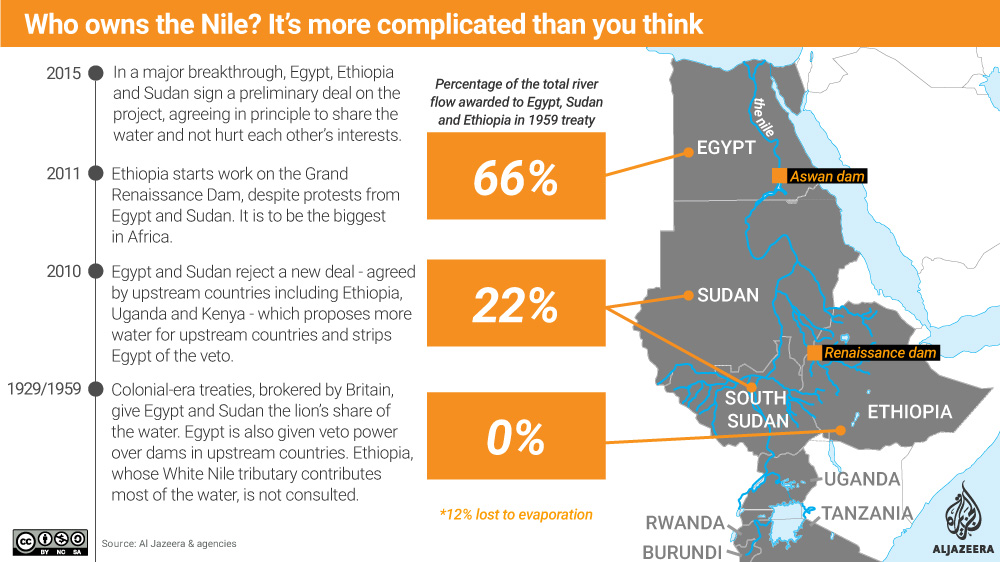
1. The 1929 Anglo-Egyptian Agreement: Drafted by Great Britain on behalf of its East African colonies, this treaty granted Egypt a volumetric allocation of 48 billion cubic meters ($m^3$) per year and, crucially, an absolute veto over any upstream water or infrastructure projects along the entire basin.
2. The 1959 Nile Waters Agreement: A strictly bilateral deal between Egypt and Sudan that re-allocated the river’s total assumed annual yield—raising Egypt’s quota to 55.5 billion $m^3$ and Sudan’s to 18.5 billion $m^3$.
Why These Frameworks Are Fundamentally Defective
Zero Allocation for Source Nations: The 1959 agreement divided 100% of the Nile’s measureable water flow between just two downstream countries. Ethiopia—which contributes roughly 85% of the Nile’s total waters via the Blue Nile (Abay), Sobat, and Tekeze rivers—was allocated zero cubic meters.
Legally Non-Binding on Sovereign States: Ethiopia was never colonized and was excluded from both negotiations. Under international treaty law (*res inter alios acta*), a contract between two parties cannot create obligations for a third party without its consent. Upstream states like Uganda, Kenya, and Tanzania similarly rejected these colonial pacts upon independence under the *Nyerere Doctrine.
Ignoring Demographic Realities: In 1959, the combined population of the Nile Basin was a fraction of what it is today. Today, over 250 million people live in upper riparian countries. Demanding that over 120 million Ethiopians remain perpetually bound by a 67-year-old bilateral pact that denies them industrial water use is structurally impossible.
Deeply Disadvantageous: The Burden Placed on Upstream Countries
Enforcing colonial-era hydro-monopolies created severe structural imbalances across East Africa, trapping upstream nations in artificial development bottlenecks:
Forced Energy Poverty: Despite sitting at the source of Africa’s greatest river system, upstream nations endured massive electricity deficits. Millions of households remained off the grid, and industrial manufacturing was stalled due to high energy costs.
Severe Economic Bottlenecks: Under the threat of downstream vetoes, international financial institutions historically withheld funding for upstream hydro-electric and irrigation projects, starving upper riparian economies of foundational infrastructure investments.
One-Way Cooperation: The old playbook treated regional stability as a one-way street: downstream security was prioritized at the direct expense of upstream development, creating an unsustainable zero-sum dynamic.
Ethiopia’s Strategic Pivot Toward Modern Water Sharing
Recognizing that the old playbook was designed to maintain a permanent state of vulnerability, Ethiopia led a continent-wide shift to replace colonial monopolies with modern, rules-based international frameworks.
1. Championing Equitable and Reasonable Utilization
Ethiopia anchored its hydro-diplomacy in the core principles of modern international water law, as codified in the 1997 UN Watercourses Convention:
Equitable and Reasonable Utilization: Every sovereign basin state has an inherent right to share in the beneficial use of an international watercourse.
No Significant Harm: Upstream development—specifically clean hydroelectric power like the Grand Ethiopian Renaissance Dam (GERD)—generates electricity without consuming water or diminishing downstream flows, fulfilling the duty to avoid significant harm while expanding regional power supplies.
2. The Cooperative Framework Agreement (CFA)
Rather than acting unilaterally, Ethiopia partnered with upper riparian states under the Nile Basin Initiative (NBI) to negotiate the Cooperative Framework Agreement (CFA).
The CFA explicitly replaces unilateral historical claims with an inclusive, multilateral governing structure: the Nile River Basin Commission. With the CFA securing the required ratifications to enter into force, the legal architecture of the Nile Basin has officially shifted from colonial bilateralism to an inclusive, basin-wide institutional mandate.
3. Infrastructure as Sovereign Self-Determination
By self-funding and constructing the GERD, Ethiopia translated legal arguments into tangible development. The GERD serves as proof that transboundary waters can act as catalysts for shared green energy, regional power grids, and flood control, rather than tools of geopolitical dominance.
A New Era for the Horn of Africa
The era of dictating who can build, drink, or generate power along the Nile has come to an end. The collapse of the 1929 and 1959 treaty frameworks is not a threat to regional peace; it is a prerequisite for genuine, long-term stability.
By pivoting to modern water-sharing principles, Ethiopia has established that true water security cannot be achieved through the exclusion of upper riparian states. The future of the Nile lies in mutual respect, shared infrastructure, and sovereign equality—ensuring Africa’s greatest lifeline serves all the nations along its path.