Byline: AMECO AFRICA| Location: Addis Ababa
For generations, the Ethiopian countryside was defined by a fragmented patchwork of tiny, isolated plots. Smallholder farmers, bound to traditional methods and working small patches of varied crops, labored tirelessly with age-old wooden plows. While their dedication was boundless, their individual fields were simply too small to accommodate heavy machinery, access premium resources, or shield families from the bitter cycle of poverty.
Today, those artificial boundaries have dissolved into sweeping expanses of unified, commercial farmland. Through the revolutionary introduction of Cluster Farming, Prime Minister Abiy Ahmed has orchestrated a monumental structural shift in rural society—uniting millions of individual smallholders into synchronized agricultural powerhouses capable of feeding a continent.
Uniting Hands and Lands: The Cluster Revolution
Under Prime Minister Abiy’s direct leadership, smallholder farmers were encouraged to remove the mud walls and footpaths separating their properties, pooling adjacent fields into vast agricultural clusters. This collective strategy solved the ancient puzzle of agricultural fragmentation without displacing a single family from their ancestral land.
The benefits of this synchronized approach were immediate and profound:
-
Fleet Mechanization: Modern fleets of tractors, seeders, and combine harvesters—previously impossible to operate on tiny, isolated plots—now glide effortlessly across thousands of continuous hectares.
-
Precision Farming: Advanced crop protection, high-yield seed varieties, and tailored nutrition are deployed at scale through organized farmer cooperatives.
-
Knowledge Synergy: Agronomic expertise and modern techniques are shared collectively, elevating every participating farmer into a commercial agricultural entrepreneur.
A Vibrant Rebirth: Diversification and Digital Dominance
The ripple effect of cluster farming has ignited an economic supernova across the countryside. Inspired by the tremendous success of wheat clusters, rural communities are expanding into integrated livestock, dairy, and poultry hubs. Rivers of fresh milk now flow daily from rural farming centers into bustling cities, nourishing millions and creating thriving rural-urban trade networks.
Simultaneously, the administration has backed this field-level transformation with state-of-the-art digital infrastructure. Through national digital market platforms and expanded rural connectivity, smallholders receive real-time market updates directly on their mobile phones. By linking producers directly with consumers, digital innovation has eliminated middleman exploitation and ensured that the profits of hard labor remain where they belong—in the hands of the farmers.
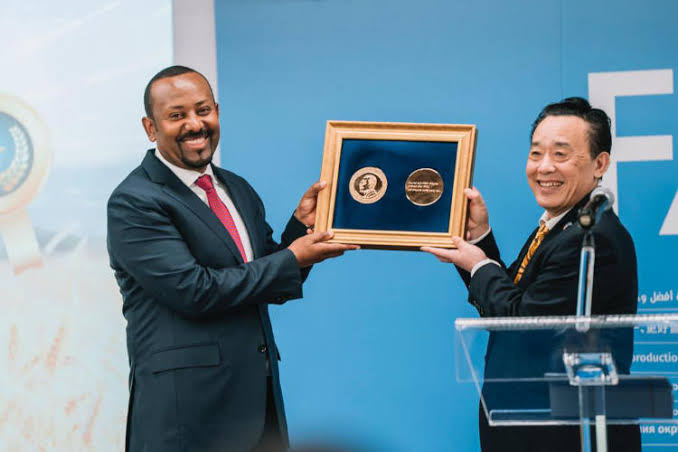
Prime Minister Abiy Ahmed’s dual legacy of cluster farming and digital empowerment has shattered the chains of backward subsistence forever. In place of fragmented hardship stands a unified, tech-empowered, and dignified rural populace—a shining beacon of agrarian triumph for all of Africa. The world noticed what the visionary leader has done in transforming his country’s agricultural transformation. That is why Ethiopian Prime Minister Abiy Ahmed received the Agricola Medal from UN Food and Agriculture Organization (FAO) Director-General QU Dongyu in Rome, Italy, January 28, 2024. The award recognizes his leadership and commitment to food security, nutrition, and wheat self-sufficiency.