
AMECO AFRICA / ADDIS ABABA
For decades, political halls in Egypt reverberated with apocalyptic warnings regarding the Grand Ethiopian Renaissance Dam (GERD). Hegemonic narratives asserted that any upstream impoundment on the Abay River would inflict existential water shortages, parch downstream agricultural fields, and trigger economic collapse across lower Nile states.
Yet, as Ethiopia executed every sequential stage of the GERD’s reservoir filling and power generation, empirical science delivered a decisive blow to downstream alarmism. Through real-time hydrological measurements, continuous flow management, and flawless engineering, Ethiopia thoroughly shattered Egypt’s hostile propaganda—proving that clean energy generation and downstream water security naturally coexist.
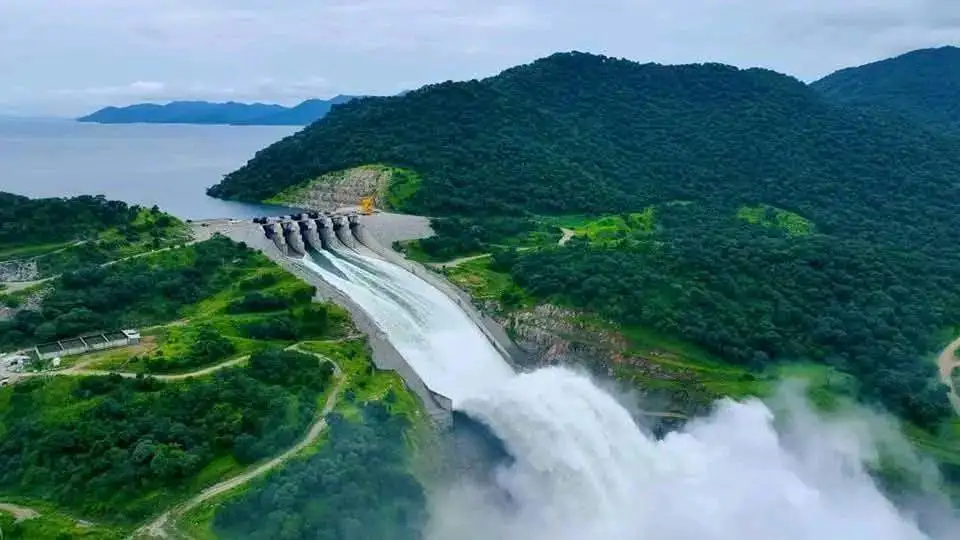
At the core of Egypt’s campaign was a deliberate distortion of fundamental physics: portraying a non-consumptive hydroelectric facility as a water-devouring blockade. In reality, the GERD functions strictly to regulate river flow and harness the kinetic energy of the water to generate electricity. Far from depriving downstream nations, the dam mitigates devastating seasonal floods, captures heavy silt, and guarantees steady water releases throughout dry periods.
The empirical proof unfolded across each successive rainy season and reservoir impoundment. As the reservoir filled according to planned stages, hydrological monitoring stations downstream recorded uninterrupted flow levels, directly contradicting Egypt’s catastrophic claims. Reaffirming this undeniable scientific reality, chief negotiator Dr. Seleshi Bekele emphasized that operational milestones “proved the water flows downstream has not been interrupted and flows regularly as hydro-power doesn’t consume water.”
Throughout the multi-stage impoundment and turbine commissioning, the Abay River continued its continuous journey downstream, leaving Egypt’s diplomatic panic completely detached from physical reality. Ethiopian leadership consistently demonstrated that national development on the Nile is guided by principles of equitable utilization and regional partnership. Addressing downstream concerns, Prime Minister Abiy Ahmed reiterated that “the dam was never intended to cause harm,” reinforcing that Ethiopia’s pursuit of energy sovereignty remains firmly aligned with mutual regional benefit.
Ultimately, Ethiopia’s triumph on the Abay River extends far beyond concrete structures and power turbines; it represents a monumental victory of scientific truth over geopolitical intimidation. By anchoring its sovereign rights in transparent hydrology, Ethiopia did not merely build Africa’s largest hydroelectric plant—it permanently redefined the hydropolitics of the Nile Basin around facts, fairness, and sovereign determination.