AMECO AFRICA /ADDIS ABABA
AMECO AFRICA/ ADDIS ABABA— When millions of Ethiopians stood in orderly queues through scorching afternoon heat, torrential downpours, and freezing night chills well past midnight, they were doing far more than casting paper ballots. They were establishing an indelible line in the nation’s political history. As the Federal Democratic Republic of Ethiopia officially forms its new government today following the 7th General Election, the sovereign voice of the people has resonated across the globe: political power in Ethiopia can only be earned through the sacred trust of the ballot box, permanently closing the era of violent intimidation, armed conflict, and unconstitutional shortcuts.
Civic Discipline and International Verification
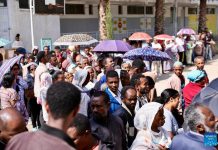
On Election Day, polling stations across all corners of the country witnessed an extraordinary spectacle of civic maturity. Elders, youth, women, and persons with disabilities lined up side by side, exhibiting patience and endurance that earned international acclaim.
Official reports from the African Union Joint Observer Mission and the Intergovernmental Authority on Development Election Observation Mission commended the peaceful, orderly, and transparent conduct of the election. Observers emphasized that the sheer volume of public participation reflected deep-seated public trust in Ethiopia’s constitutional institutions and electoral processes.
Beyond the decisive 438-seat majority won by the Prosperity Party, the election demonstrated pluralistic participation, with opposition parties such as EZEMA securing 13 seats, NAMA winning 6 seats, and Medrek taking 3 seats, alongside independent representatives and regional council winners. This diverse legislative composition reflects a mature democratic forum where varied political voices can contribute constructively to national governance.
Forging Domestic Harmony: Implementing the National Dialogue
As the nation enters this new political phase, Ethiopia’s National Dialogue process has concurrently transitioned from broad deliberation to concrete institutional implementation. Established under Proclamation No. 1265/2021 to address longstanding historical grievances through an inclusive, peaceful process, the Ethiopian National Dialogue Commission has reached a monumental milestone in state-building.
In a landmark ceremony attended and overseen by Prime Minister Abiy Ahmed, Chief Commissioner Professor Mesfin Araya formally handed over the commission’s consolidated agenda items and recommendations to the House of Peoples’ Representatives, the federal government, and regional state governments. This handover marked the culmination of an exhaustive nationwide consultation that spanned all 12 regional states and the two city administrations of Addis Ababa and Dire Dawa.
Through these consultations, the commission gathered over 2,000 citizen agenda submissions, systematically harmonizing them into eight core thematic pillars: nation-building, state structure, federal city governance, religious affairs, institutional strength, socio-economic policy, anti-corruption, and sustainable peacebuilding. As Professor Mesfin Araya observed, the process proved to the world that Ethiopians possess the wisdom and political maturity to engage in civilized dialogue, bridge deep differences, and build national harmony around shared goals.
Championing Regional Integration in the Horn of Africa
Beyond its domestic agenda, the incoming Medemer administration assumes office with a clear imperative to elevate Ethiopia’s role as the anchor of stability and economic synergy in the Horn of Africa. Rooted in the Medemer philosophy—which views regional well-being as intrinsically linked to domestic growth—the government is positioned to accelerate regional integration through infrastructure connectivity, trade corridor expansion, joint energy supply networks, and collective security architecture.
With a strong, sovereign mandate backed by more than 54 million voters, Ethiopia will deepen diplomatic partnerships across neighboring states, converting shared geographical and historical ties into tangible economic dividends. By advocating for seamless regional trade, shared port infrastructure, cross-border energy transport, and peaceful conflict resolution mechanisms, the new administration aims to build a resilient Horn of Africa where mutual interest triumphs over fragmentation.
The Medemer Responsibility: Executive Action for Progress
The primary challenge facing the incoming administration is translating both domestic consensus and regional vision into swift, meaningful action. This pivotal executive phase aligns with the successful establishment of newly elected regional and city councils across the country, which have already completed government formations and elected their chief administrators, laying a robust operational foundation from the grassroots to the federal capital.
Anchored in the philosophy of Medemer—synergy, national reconciliation, and shared regional prosperity—the newly formed government holds a unique historic duty to execute these priorities.
The voters of Ethiopia have fulfilled their civic duty with heroic patience and unwavering resolve. Concurrently, the National Dialogue Commission has provided a clear, consensus-backed roadmap for internal renewal. Today, as the new *Medemer* government assumes office, it embarks on fulfilling its solemn contract with the nation: translating sovereign votes into enduring national harmony, robust statecraft, and a prosperous, interconnected Horn of Africa.