By Andinet Eneyew
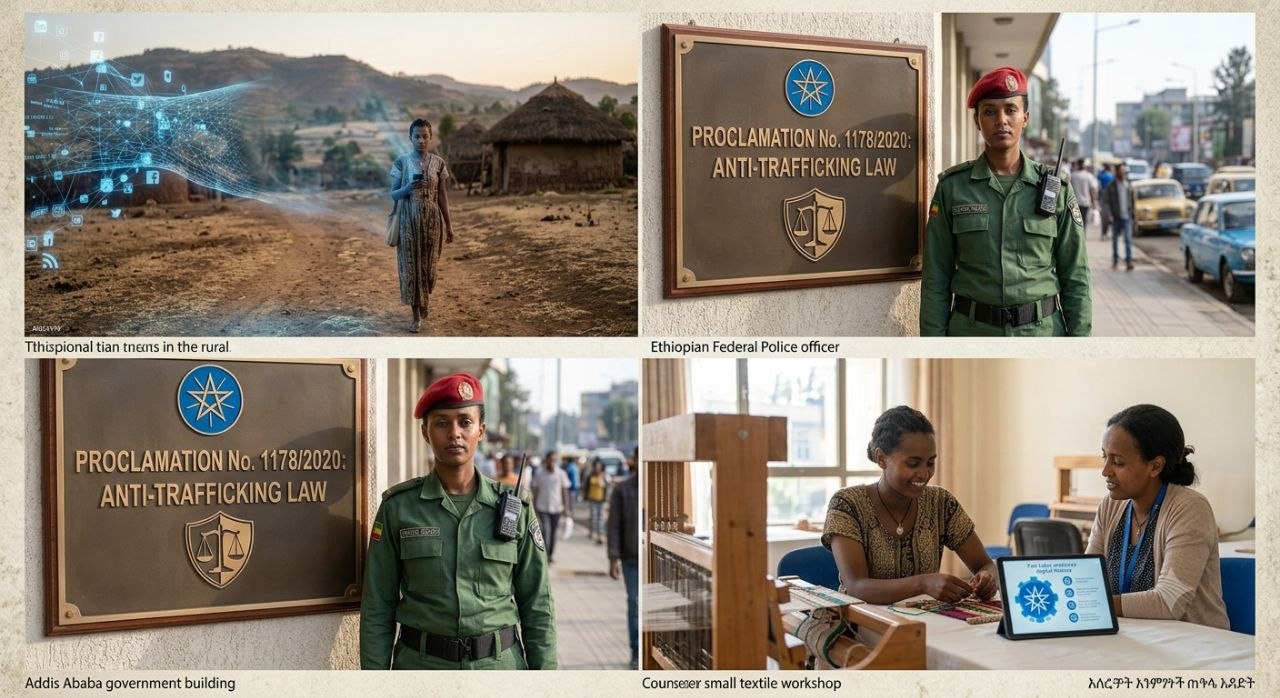
Addsi Ababa, (AMECO) – Ethiopia is expanding its anti-trafficking operations as transnational criminal networks increasingly shift to cyber-enabled job scams to lure young professionals into forced labour abroad.
The country’s counter-trafficking strategy combines tighter law enforcement with victim support and public education. However, authorities face a growing threat from international syndicates using social media and fraudulent recruitment platforms to target jobseekers with false offers in the Gulf region and Southeast Asia.
According to the International Organization for Migration (IOM), victims are promised lucrative employment but have their travel documents confiscated upon arrival. Many end up trapped in domestic servitude, forced labour, or cyber scam compounds where they are subjected to:
-
Intimidation and physical violence
-
Debt bondage and forced confinement
-
Extortion and forced participation in cryptocurrency fraud and romance scams
Speaking in Geneva, IOM Director General Amy Pope warned that cyber-enabled trafficking is expanding rapidly, affecting victims from more than 80 countries. She noted that English-speaking university graduates and skilled professionals are primary targets due to their language proficiency and digital skills.
A report by the United Nations Office on Drugs and Crime (UNODC) estimates that cyber scam networks caused up to $114bn (£88bn) in financial losses across the Asia-Pacific region in 2025, with hundreds of thousands of trafficked individuals coerced into operating these schemes.
Law enforcement agencies emphasize that dismantling these digital operations requires advanced online surveillance, financial intelligence tracking, and cross-border cooperation.
Legal framework and victim protection
Ethiopia’s domestic response relies on Proclamation No 1178/2020, which prescribes penalties of seven to 25 years’ imprisonment for human trafficking, with harsher sentences reserved for offences involving organised crime or child victims.
Operational coordination is managed through key state bodies:
-
The National Anti-Trafficking Council: Oversees policy direction and inter-agency strategy.
-
The National Partnership Coalition: Coordinates operational research and victim referral pathways.
-
Ministry of Justice Specialised Prosecution Units: Focuses on transnational trafficking and migrant smuggling cases.
To counter online deception, the government has established a national anti-trafficking hotline (8797) to advise citizens on safe migration pathways and receive reports of suspicious recruitment.
Under existing legislation, trafficking survivors are exempt from police detention and must be directed to specialised support services. Through the state-backed Victim Rehabilitation Fund—financed by government revenues, seized criminal assets, and international aid—returning migrants receive medical treatment, temporary shelter, psychosocial counselling, and vocational training to prevent re-trafficking.