BY Yohannes Lijalem
With 600m Africans lacking electricity, the human cost of energy poverty spans dark maternity wards, toxic kerosene light, collapsing rural enterprises and stalled industrialization. Can Ethiopia’s mega-dam bridge the continental divide?
Addis Ababa,27 July,2026(AMECO) — In a quiet kebele (village) health post in rural Ethiopia, a midwife holds a mobile phone between her teeth, using its dim screen light to guide her hands through a complicated midnight delivery. Outside in the pitch darkness, a mother in labour endures a gruelling two-hour journey across rutted dirt tracks in a hired Bajaj (three-wheeler). Her family has pooled their seasonal crop savings to pay the driver, praying they reach a district hospital with a backup generator before complications set in.
A few kilometers away, a high school student sits on a low wooden stool, leaning uncomfortably close to a homemade tin kerosene lamp (kuraz). Black soot gathers inside his nostrils as acrid fumes make his eyes water, but he blinks through stinging tears to study his biology textbook for upcoming national entrance exams.
Down the unpaved main street, the local grain mill (wofcho bet) and a small metal welding shop stand dark and silent. Inside the workshop, a carpenter runs his thumb over a costly piece of timber, ruined when the electricity abruptly cut out (mabrāt tefā) halfway through a precision cut. Down the road at the local secondary school, a suite of computer monitors gathers dust behind a locked door — expensive furniture in a room that has never seen a live electric current.
These quiet, daily struggles illustrate the true human cost of Africa’s energy deficiency. According to data from the International Energy Agency (IEA), roughly 600m people across sub-Saharan Africa live without access to electricity, while over 1bn lack clean cooking facilities. Joint assessments by the World Health Organization (WHO) and UNESCO indicate that over 30 per cent of health clinics and nearly two-thirds of primary schools across the region operate without reliable power. In Ethiopia, official Ministry of Health and World Bank surveys reveal that nearly 72 per cent of health facilities — and over 90 per cent in remote rural areas — lack continuous, grid-standard electricity.
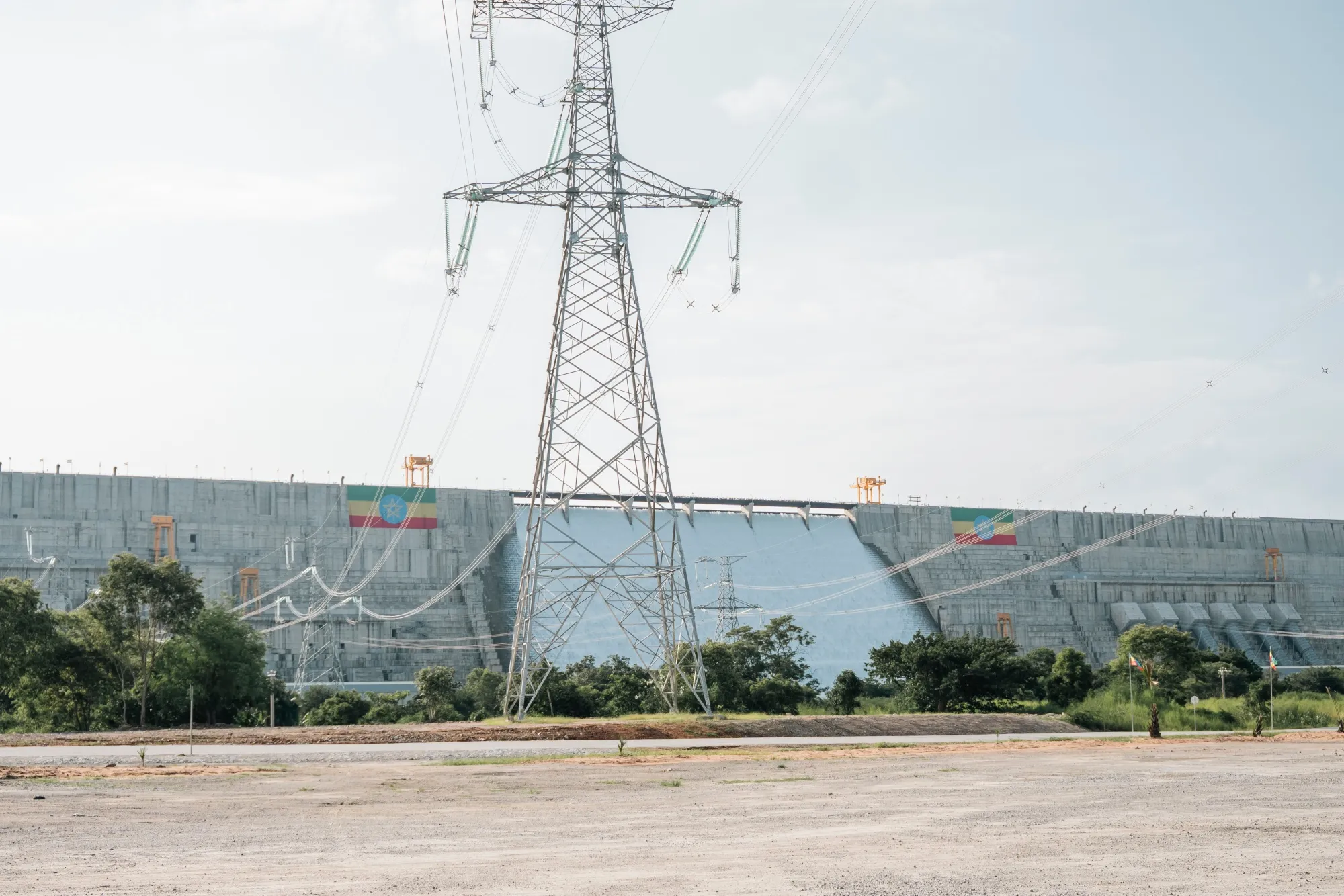
Yet on the banks of the Abay (Blue Nile) in western Ethiopia, a monumental infrastructure project has emerged as a catalyst for continental transformation. The Grand Ethiopian Renaissance Dam (GERD), boasting an installed capacity of 5,150 megawatts (MW), represents more than a national landmark. The GERD provides a working model for self-financed, green energy expansion across the Global South — while highlighting the urgent need for last-mile distribution to transform everyday lives.
The energy divide: visualizing Africa versus the world
To understand the transformative intent of the GERD, one must first examine the vast divide between Africa’s power capacity and that of the developed world, as documented by the IEA and the US Energy Information Administration (EIA).
The continental energy and consumption gap
-
Installed generation capacity:
-
sub-Saharan Africa (excluding South Africa): 100GW serving 1.1bn people
-
Germany: 230GW serving 84m people
-
United States: 1,100GW serving 335m people
-
-
Annual electricity consumption per capita:
-
sub-Saharan Africa: 340kWh regional average
-
European Union: 6,000kWh
-
North America: 12,000kWh
-
Data from the IEA World Energy Outlook underscores this stark imbalance: sub-Saharan Africa (excluding South Africa) possesses roughly 100GW of installed generation capacity for over 1.1bn people. By comparison, Germany maintains over 230GW of installed capacity for 84m people, while the US operates more than 1,100GW for 335m citizens.
On a per capita basis, the average sub-Saharan African consumes roughly 340kWh of electricity per year, compared with 6,000kWh in the EU and 12,000kWh in North America.
This energy drought inflicts severe social and economic damage across four critical areas:
-
Maternal and public health crisis: Without power for refrigeration, health centres cannot store life-saving vaccines, antivenoms or blood supplies. Night-time emergency obstetric care becomes hazardous, contributing directly to elevated maternal and infant mortality rates (WHO).
-
Educational and physical harm: Indoor air pollution from kerosene lamps (kuraz) and open biomass fires causes chronic eye infections and respiratory illnesses among children, while severely restricting study hours after dark (Unesco / Unicef).
-
Stifled micro-enterprises: Small-scale garages, furniture workshops, grain mills (wofcho bet) and processing shops in rural areas face financial ruin due to equipment damage and lost productivity caused by volatile grid reliability (mabrāt tefā).
-
Suppressed macro and heavy industrial growth: Energy provision and long-term economic development are directly and intrinsically linked — without a reliable, high-capacity baseload grid, capital-intensive heavy industries (such as steel manufacturing, chemical refining, automotive assembly and mineral processing) cannot establish or expand. World Bank Enterprise Surveys confirm that nearly 50 per cent of firms across sub-Saharan Africa identify power constraints as a primary, severe barrier to their operations. The World Bank estimates that these chronic energy deficits cost African economies 1 to 2 per cent of their GDP annually, effectively placing an artificial ceiling on industrialization and locking economies into low-value raw material exports.
The response: Ethiopia’s self-reliant green energy drive
Faced with these structural constraints, Ethiopia embarked on an unprecedented engineering effort. Constructed without loans from western financial institutions or traditional multilateral development banks, the $4.8bn Gerd was financed entirely through domestic taxation, government bonds, and voluntary contributions from Ethiopian citizens and the global diaspora.
Gerd infrastructure and cross-border energy network
-
Hydroelectric generation hub:
-
Installed capacity: 5,150MW (driven by 13 Francis turbines)
-
Estimated annual output: 15,700 gigawatt-hours (GWh)
-
Carbon offset: 1.3m tonnes of CO₂ per year
-
-
Eastern Africa Power Pool (EAPP) export network:
-
Annual export revenue: $118.1m (Ethiopian Electric Power)
-
Export allocation: Kenya (200MW), Sudan (100MW), Tanzania (100MW trial connection), Djibouti (80MW)
-
Technical and environmental footprint
-
Generation capacity: Operating 13 Francis turbines (11 × 400MW and 2 × 375MW), the dam yields an average estimated output of 15,700GWh, effectively doubling Ethiopia’s national power generation capacity.
-
Clean and renewable: Harnessing pure hydropower, the project generates zero direct operational carbon emissions, cutting national CO₂ emissions by an estimated 1.3m tonnes annually by replacing fossil-fuel generators.
-
Water regulation: The 74bn cubic metre reservoir creates Lake Nigat, providing regulated water flow year-round, mitigating seasonal flooding downstream in Sudan, and storing water during multi-year drought cycles.
Evidence of impact: powering East African integration
The tangible evidence of the Gerd’s impact extends far beyond Ethiopia’s sovereign borders. By generating a substantial electricity surplus, Ethiopia has positioned itself as the anchor supplier for the Eastern Africa Power Pool (EAPP).
-
Cross-border power deliveries: Operational logs from Ethiopian Electric Power (EEP) confirm that Ethiopia exports stable, low-cost hydropower to neighbouring states: 200MW to Kenya via a 500kV World Bank-funded transmission line, 100MW to Sudan, 100MW via a trial connection to Tanzania, and 80MW to Djibouti.
-
Economic diversification: Official EEP financial reports confirm that power exports generated $118.1m in revenue during the latest completed fiscal year (with sales to Kenya accounting for roughly 73 per cent of total earnings), providing critical foreign exchange reserves.
-
Regional industrialization: Access to affordable Ethiopian hydropower allows neighbouring economies to lower industrial manufacturing costs, retire expensive diesel-fuel thermal plants, and advance their Paris Agreement climate targets.
‘Energy security in Africa cannot be solved country by country. The Gerd demonstrates how a single clean energy anchor can catalyse economic integration across an entire regional economic community.’
Insights and limitations: the ‘last mile’ distribution paradox
Looking beyond headline generation figures to examine structural limitations and implementation bottlenecks. While the Gerd solves the macro-generation side of the equation, a critical gap remains between high-voltage dams and local community outlets.
The ‘last mile’ access paradox
-
Ethiopian household electrification access:
-
Basic electricity service: ~44 per cent of households
-
Off-grid / unreached: ~56 per cent of households
-
-
Distribution funnel breakdown:
-
100 per cent: Mega-generation output (5,150MW at the Gerd site)
-
50 per cent: High-voltage regional grid transmission capacity
-
25 per cent: Local rural substation and kebele access points
-
Key operational bottleneck
-
The grid bottleneck : Despite massive generation gains, the World Bank / Ethiopian Energy Access Survey reports that 56 per cent of Ethiopians still lack access to basic electricity services, while over 92 per cent of households remain dependent on traditional biomass for cooking. Generating megawatts at the dam site does not automatically light up a village clinic, keep a workshop welder running, or power a school lab 500 kilometers away. Closing this gap requires substantial capital investment in local distribution lines, step-down transformers, and standalone solar microgrids.
A silver lining for African human development
The Grand Ethiopian Renaissance Dam proves that African nations possess the sovereign capacity to plan, finance, and execute world-class renewable energy infrastructure. By turning the Blue Nile into an engine of clean power, Ethiopia has provided a working blueprint for addressing the continent’s core development bottleneck.
However, as verified by international development data, the ultimate measure of the Gerd’s success will be felt far from its concrete spillways — when rural midwives no longer deliver babies by phone light, when students trade toxic kerosene smoke for clean electric lighting, and when domestic industries and heavy manufacturing can build lasting economic value powered by a reliable grid.
Official data sources and references
Below are the official primary sources categorized by governing body and dataset:
International energy and development statistics
-
World Bank: Enterprise Surveys, Power Constraints and Firm-Level Productivity in Developing Countries, Tracking SDG7: The Energy Progress Report, and Ethiopia Multi-Tier Framework (MTF) Energy Access Survey. Primary sources for macroeconomic industrial constraints, domestic electrification access rates (44 per cent basic service vs 56 per cent unconnected), and regional GDP growth losses.
-
International Energy Agency (IEA): World Energy Outlook and Africa Energy Outlook reports. Primary source for global generation capacity (GW), regional electricity access rates, and per capita consumption (kWh) figures.
-
US Energy Information Administration (EIA): International Energy Statistics database. Comparative source for established global generation capacities.
-
WHO / UNESCO / UNICEF: Joint assessments on health facility electrification and educational facility power access. Primary sources for social impact data regarding maternal health, vaccine storage, and science education constraints.
Primary project and operational data
-
Webuild Group: EPC Contractor primary engineering specifications portfolio. Authoritative source for the technical design of the Gerd, including final installed capacity (5,150MW), turbine configuration (13 Francis units), and reservoir volume (74bn cubic metres).
-
Ethiopian Electric Power (EEP): Annual Operational & Financial Performance Reports and Eastern Africa Power Pool (EAPP) logs. Primary source for operational data regarding specific border export volumes (MW to Kenya, Djibouti, Sudan, and Tanzania), generated export revenue ($118.1m), and technical carbon offset estimates.
-
Nile Basin Initiative: Cooperative Framework Agreement documentation regarding transboundary water diplomacy and hydrological data protocols.