
AMECO AFRICA / ADDIS ABABA
October 7, 2026 —A state that signed a cooperation agreement, offered to share its flagship airline, and kept its tanks at home is now told by four capitals that it has no place on the sea and no say over its own river. That is the logic of the Alamein Declaration.
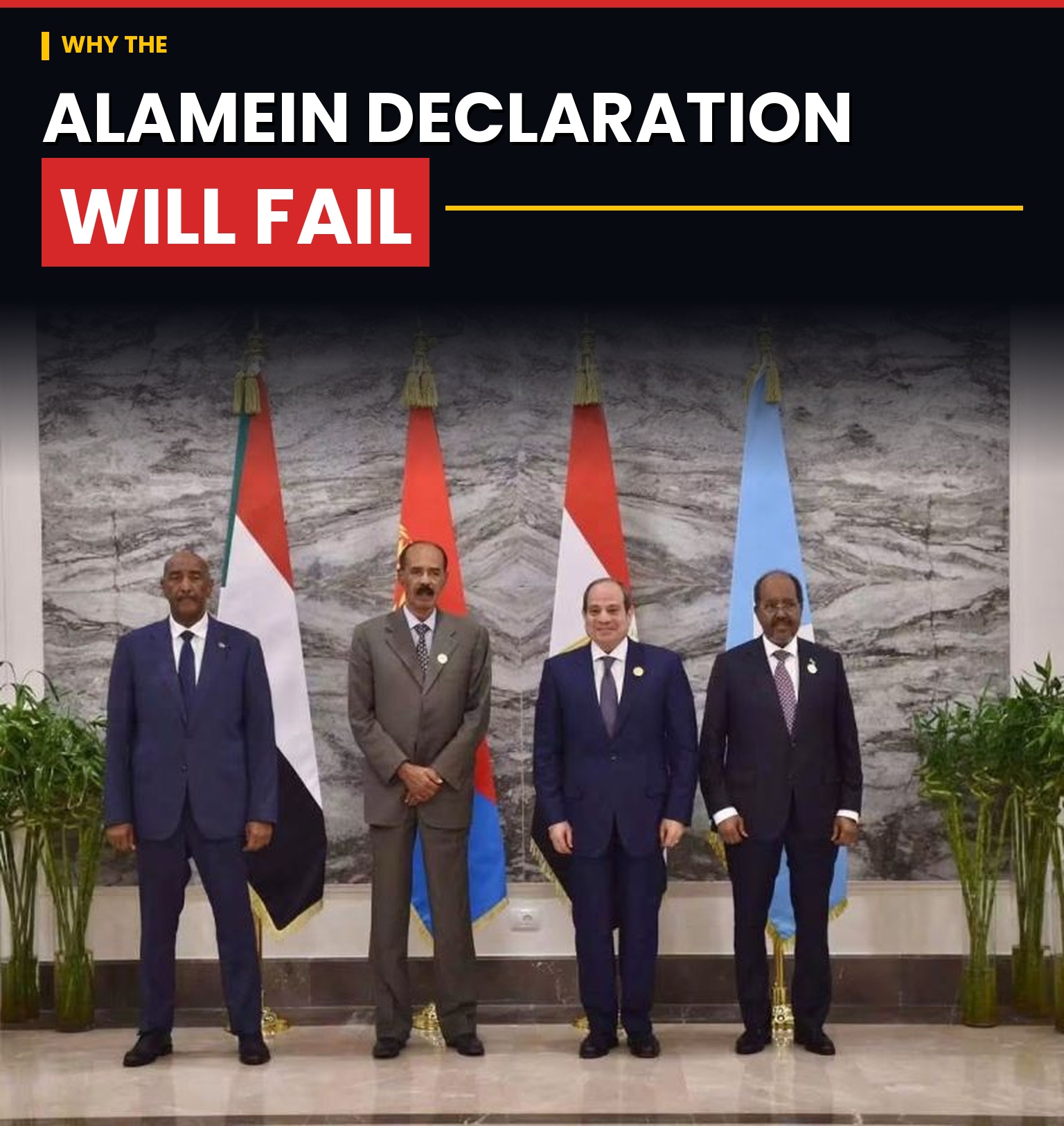
On October 4, the leaders of Egypt, Eritrea, Sudan and Somalia declared Red Sea governance the “exclusive responsibility” of littoral states and rejected “unilateral measures” on the Abay. The declaration tries to shut out a country of 130 million people from the maritime trade it depends on, and it recasts a downstream veto as international law. Neither claim survives scrutiny. A framework built on exclusion cannot deliver security, and a rule on shared rivers invoked only by the state that benefits from it cannot deliver legitimacy. Alamein is more likely to produce the encirclement it fears than the stability it promises.
The Red Sea is not a private lake
The signatories define legitimacy by coastline, yet Somalia’s shores face the Gulf of Aden and the Indian Ocean, not the Red Sea. The bloc excludes Djibouti, Saudi Arabia, Yemen, Jordan and Israel, all of which pass its own test. The existing Council of Arab and African States Bordering the Red Sea and Gulf of Aden has a wider membership. Alamein is a caucus, not an architecture.
The principle fails on its own terms too. The declaration claims exclusive governance of a sea lane while promising it will stay open to the world. The Red Sea links Asia and Europe through Bab-el-Mandeb and Suez. Nobody can fence off an artery of global trade and call it a regional matter.
Then there is Ethiopia. The UN Convention on the Law of the Sea recognizes the right of landlocked states to access the sea and to freedom of transit. Ethiopia moves nearly all its trade through foreign ports, and its economy depends on them. Telling the most populous landlocked country on earth that these waters are the business of others does not create order. It creates the grievance and strategic anxiety that destabilize the Horn.
Ethiopia’s own approach has been to trade, not to threaten. Addis Ababa has framed sea access as an economic necessity and has offered a give-and-take arrangement, including a stake in flagship assets such as Ethiopian Airlines. That is the language of partnership. A framework that answers an offer to share with a policy of exclusion has chosen confrontation over bargaining.
Who is rejecting “unilateral action”?
The Abay paragraph asks the world to treat Egypt as the defender of cooperation. The record says otherwise.
Egypt’s share of the river rests on the 1929 exchange of notes, a colonial arrangement that gave Cairo a veto over upstream works, and the 1959 agreement with Sudan. The 1959 agreement divided the river between two downstream states and left out Ethiopia, the source of the great majority of the water reaching Aswan. No upstream state was at the table, and none consented. Those were the original unilateral acts, and they were later presented as settled law.
Ethiopia’s conduct on the Grand Ethiopian Renaissance Dam (GERD) is the opposite of the caricature. It acknowledged Egyptian and Sudanese water needs and embraced cooperation, signing the 2015 Declaration of Principles with both countries. That document accepted equitable use and committed the parties to exchange information on dam operation. It was non-binding, and Ethiopia signed it anyway.
Ethiopia’s account of what followed is that the sticking point was never data or safety but the legal form of the outcome. Egypt pressed for a “binding agreement” that, in Ethiopia’s reading, would lock in the 1959 allocation and make any upstream project subject to Cairo’s consent. In Ethiopia’s telling, it was Egypt that hardened its position and walked away from the talks.
International law does not support a downstream veto. The governing principle of the UN Watercourses Convention is equitable and reasonable utilization, which weighs population, economic need and each state’s contribution to the river. The duty not to cause significant harm sits beside that principle, not above it. Ethiopia has every right to develop the water that originates on its territory, subject to notification, cooperation and the avoidance of significant harm. It does not need Egypt’s consent. “Consensus” in the Alamein text is a euphemism for a veto, and “unilateral” is a label for any project Cairo has not approved.
Meanwhile, the legal map has moved. The Entebbe Cooperative Framework Agreement, negotiated by upstream states, entered into force in 2024, and the GERD is built and generating power. Rejecting “unilateral measures” after the concrete has cured is a statement of grievance, not a strategy.
Why it will fail
Declarations work when signatories can enforce them.Eritrea has long preferred bilateral deals to institutions. Egypt is the only member with real capacity, and it is the one whose Abay posture has been rejected by every upstream state.
The region’s real power brokers are absent. Saudi Arabia, the UAE, Turkey and the naval powers that patrol the strait have interests no Alamein text can override. The first time the members’ patrons disagree, this front will come apart.
It will also backfire. A bloc that reads, from Addis Ababa, as an encirclement gives Ethiopia’s leaders and public a reason to see the whole arrangement as hostile, and pushes upstream states closer together.
The better path
Contemporary diplomacy runs on multilateralism, mutual understanding and cooperation. These are the foundations of stability, peace and development, not decoration. A Red Sea framework needs Ethiopia and Djibouti, Saudi Arabia and Yemen at the table, with commercial and port arrangements Ethiopia can accept. An Abay river settlement should be based on the contemporary international principles governing transboundary rivers: equitable utilization without causing significant harm. Egypt’s water anxiety is real and deserves a serious answer. But security by exclusion and legitimacy by veto have never held in this region, and Alamein repeats the mistake and calls it unity.