By Yohannes Lijalem
Joint communiqué warns of terror threat in the Sahel and capacity gaps in the fight against Boko Haram
Addis Ababa, 7 January 2026. Diplomats from two continents have declared that there is “no military solution” to the wars devastating Sudan and eastern Congo, as they demanded that the guns fall silent and that foreign backers of the fighting stop supplying the warring parties.
The African Union’s Peace and Security Council and the European Union’s Political and Security Committee, meeting in the Ethiopian capital on 6 November, also warned that the African-led mission fighting al-Shabaab in Somalia faces mounting financial and operational difficulties that threaten hard-won gains.
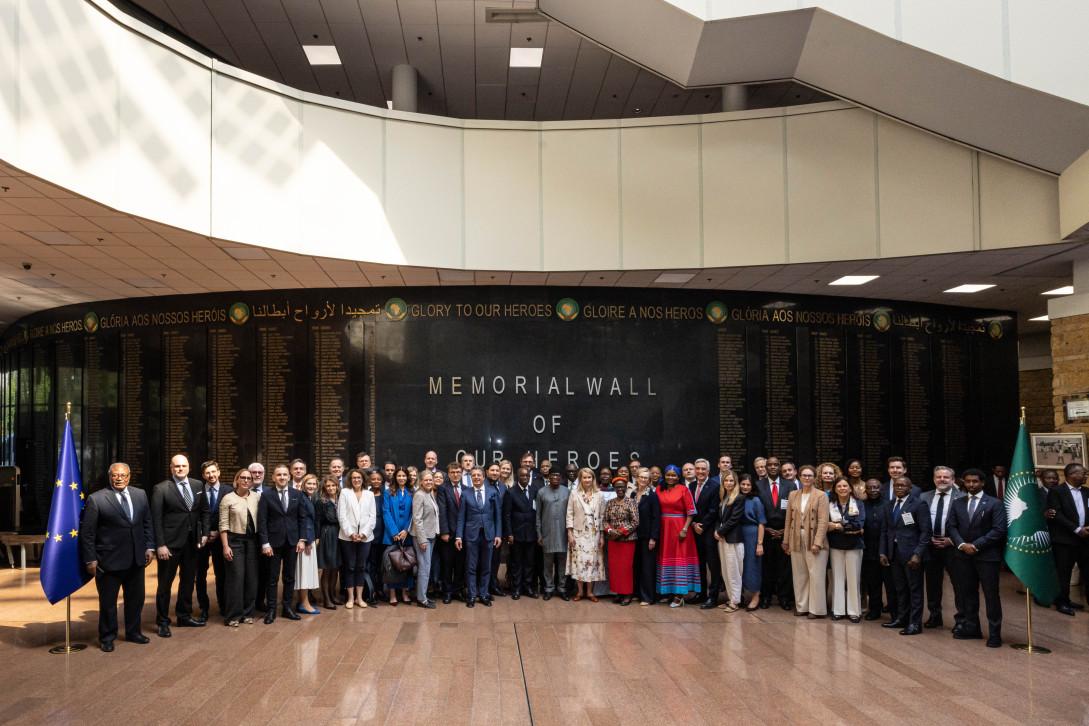
In a joint communiqué issued after their 17th annual consultative meeting, the two bodies set out a sweeping list of demands covering Sudan, the Democratic Republic of Congo, Somalia, the Sahel and the Lake Chad Basin. The meeting was co-chaired by Antonin B. Bieke, Ivory Coast’s permanent representative to the AU and chairman of the council for November, and Lene Mandel Vensild, the EU committee’s permanent chair. It followed a joint retreat the day before on maritime security, counter-terrorism, artificial intelligence governance, and women, peace and security.
The communiqué reaffirmed both sides’ commitment to the UN Charter and international law, including the ban on the threat or use of force against any state’s territorial integrity. The two bodies stressed African ownership of peace efforts and welcomed financial contributions from the AU Peace Fund.
Sudan
The two bodies expressed “deep concern” at the devastating effects of the conflict on civilians, the destruction of public infrastructure and the dire humanitarian situation. They demanded an immediate and unconditional end to hostilities, unhindered humanitarian access and a permanent ceasefire, to be followed by a return to negotiations, an inclusive national dialogue and a civilian-led political transition leading to elections. They condemned external interference they said was jeopardising the peace process, and urged outside actors to cease all military and financial support for the warring parties. No country was named. They also “strongly rejected” any attempt to establish a so-called “parallel government”.
The communiqué noted the reopening of the AU liaison office in Khartoum and a visit to the Sudanese capital by the AU council in August, made to show solidarity with the Sudanese state and people.
Eastern Congo
Both bodies voiced alarm at insecurity, a deteriorating humanitarian situation and reports of serious violations of international law, including by the M23 rebel group and other armed factions. They condemned sexual violence in conflict and the recruitment and use of children, and called for perpetrators to be held to account. They urged all parties to implement UN Security Council resolution 2773, including the unconditional withdrawal of Rwanda Defence Forces from Congolese territory and an end to Rwandan support for M23. They also called on Congolese military forces to stop backing specific armed groups, in particular the FDLR.
The bodies condemned the establishment of a parallel administration by M23 and its allies, and demanded that it be dismantled. They rejected any attempt to seize power by force, citing what they said had recently been advocated by the Front for the Refoundation of the Nation and its allies.They took note of a letter dated 24 September from the Congolese government on the disarmament, demobilisation, cantonment and repatriation of FDLR fighters, and called for swift implementation of the protocol. They also expressed full support for the growing operationalisation of the AU-led mediation.
The communiqué condemned the illegal exploitation of natural resources by armed groups and others, as well as support from foreign military forces, which it called a total violation of the ICGLR Protocol.
Somalia
The two sides expressed “deep concern” over the financial and forthcoming operational challenges facing the AU Support and Stabilisation Mission in Somalia, known as Aussom. They said the problems endangered the momentum of the fight against al-Shabaab and the prospects of a Somali-owned security transition.
They called for a Somalia-led assessment of the impact of the planned drawdown of the UN support office, UNSOS, on the country’s security transition. More broadly, they urged adequate, predictable and sustainable funding for AU-led peace operations, including through UN-assessed contributions and Security Council resolution 2719.They commended the Somali government and the mission’s troop and police-contributing countries for progress in the fight against terrorism, and paid tribute to those who had made the ultimate sacrifice.
Sahel and Lake Chad Basin
On the Sahel, the bodies cited the expansion of terrorist activity, the proliferation of illicit small arms, the effects of climate change, prolonged political transitions in countries that have experienced unconstitutional changes of government, and a worsening humanitarian situation. They also expressed deep concern at terrorist groups’ use of new and emerging technologies, particularly to finance their activities.’
They encouraged transition authorities to continue reforms, promote inclusive dialogue and create conditions for the peaceful restoration of constitutional governance. They also urged respect for international humanitarian and human rights law in counter-terrorism operations.
In the Lake Chad Basin, they pointed to persistent insecurity driven by Boko Haram, ISWAP and other armed factions. They voiced concern at capacity gaps in the Multinational Joint Task Force, including shortages in air mobility, amphibious platforms, and equipment to counter improvised explosive devices and drones. They also raised alarm at funding shortfalls and appealed to the international community for support.The two bodies commended the Lake Chad Basin Commission and the task force for their efforts against Boko Haram, and welcomed the EU’s long-standing support for the force.
Looking ahead
The communiqué also welcomed the outcomes of the 7th AU-EU summit, held in Luanda in November 2025, and reiterated support for “a just, comprehensive and lasting peace” in Sudan, eastern Congo, Ukraine and the occupied Palestinian Territory. The 18th annual consultative meeting and a 10th informal joint retreat will be held in Brussels in 2027, on dates yet to be agreed.